
| ISBN |
|---|
| 978-977-86205-8-0 |
| Author |
| Dr. Hamid Dabashi |
| Translation |
| Dr. Amal Hamada |
| Edition |
| 1st, 2026 |
| Language |
| Arabic |
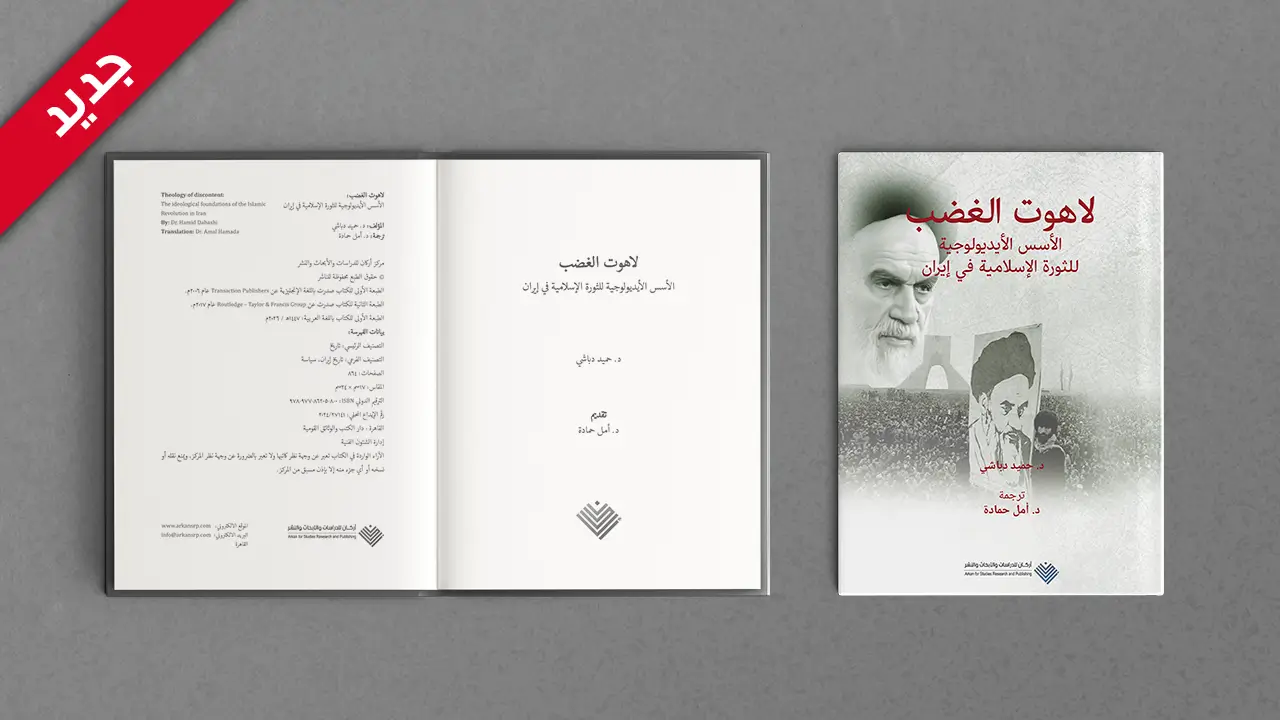
About the Book:
In this substantial work, Hamid Dabashi seeks to map how Iranian intellectuals—both from within the religious establishment and beyond it—interpreted the West and its relationship with Islam, and how this interpretation shaped the intellectual foundations of the Islamic ideology that succeeded in mobilising the masses in 1979, in what became known as the Iranian Islamic Revolution.
The book examines the shared elements among the diverse and often competing intellectual currents in Iran regarding their perception of the West. This complex perspective portrays the West as an enemy and an absolute evil, a unified entity perceived as lying in wait against Islam and the East. At the same time, it also engages with Western political, technological and economic experiences as an ideal point of comparison through which the transformations experienced by Iranian society during the twentieth century were measured, ultimately leading to the overthrow of the Shah’s regime in February 1979.
Throughout the book, Dabashi at times explicitly states—and at other times subtly suggests—the manner in which Iranian intellectual currents approached the West and its rationalist and modernising experience as though it were a monolithic whole, often overlooking the differences and internal distinctions within Western societies themselves.
Each chapter is titled after a particular thinker, accompanied by a descriptive epithet that encapsulates the essence of his intellectual contribution. After outlining the key historical events that Dabashi considers to have paved the way for the revolutionary forces—from the early twentieth century to the political rupture that culminated in the Shah’s departure—the discussion begins with Jalal Al-e Ahmad, whom Dabashi regards as a pivotal historical moment representing the earliest signs of Islamic ideological formation. The narrative then proceeds through the ideas of Ali Shariati, Morteza Motahhari, Mahmoud Taleghani, Mohammad Hossein Tabataba’i and Mehdi Bazargan, before concluding with Abolhassan Bani-Sadr and Ayatollah Khomeini, who, for a range of historical and political reasons, proved able to synthesise the forces and ideas of that transformative historical moment.
The book is written by the Iranian philosopher and intellectual Hamid Dabashi, and translated and introduced by Dr. Amal Hamada, Professor of Political Science.



Leave A Comment